‘The overall scope of the present work,’ Hans Urs von Balthasar writes in the foreword of The Glory of the Lord, ‘naturally remains all too Mediterranean. The inclusion of other cultures, especially that of Asia, would have been important and fruitful.’ Confessing that his ignorance would have led to a ‘superficial presentation’ and ‘dilettanitism,’ he invites ‘those qualified to complete the present fragment’ to continue his work (Seeing the Form, 12).
I am by no means qualified to continue Balthasar’s project, much less to extend its insights to Asia. I am a geographer of religion whose small splash in the discipline has been my work on ‘grounded theologies,’ with a focus on the region that scholars have come to call the ‘transpacific.’ In this way, I am not a scholar of ‘Asia’ in the strictest of senses; if anything, my commitments are much more to a capacious and radical understanding of Asian American studies as an international phenomenon than to the old area studies category of ‘Asian studies.’
There’s a bigger story as to why I’m interested in Balthasar, his spiritual companion Adrienne von Speyr, and their secular Community of St John. When I was a high school student, I learned creative writing from a Holy Cross priest named Fr Harry Cronin CSC, who was also playwright-in-residence at the Graduate Theological Union in Berkeley, California. At the time I wasn’t Catholic — I later did become Eastern Catholic and ended up blogging on Patheos Catholic for three years — but I became very taken with how Fr Harry talked about being caught up in the ‘theo-drama’ of a great narrative and finding its plot points in the ‘pattern of redemption.’ I later learned that that was how Edward T. Oakes describes the arc of Balthasar’s work.
Like Karen Kilby, I do find Balthasar and Speyr’s work problematic for many reasons, especially those related to feminist agency. I’m also aware that their German idealism is not going to work for a cultural geography of the transpacific. But this is why I am going to try to read Balthasar’s triptych — The Glory of the Lord, Theo-Drama, and Theo-Logic — over the next three years in what might be called a dialogical way. Too many people, I feel, try to read these books as master texts, as if the pattern of redemption as Balthasar and Speyr describe it has to apply to their lives perfectly.
But if indeed the Community of St John is meant to accompany a Godforsaken secular world through the abyss of Holy Saturday’s death of God, then the only way to read it is through accompaniment. Along the way, there will be secular authors, probably a good deal of Asian American, transpacific, and Sinophone writers, if I’m going to be honest, and most of them writing in English or read in English translation, because I haven’t the time to do more than that on a blog.
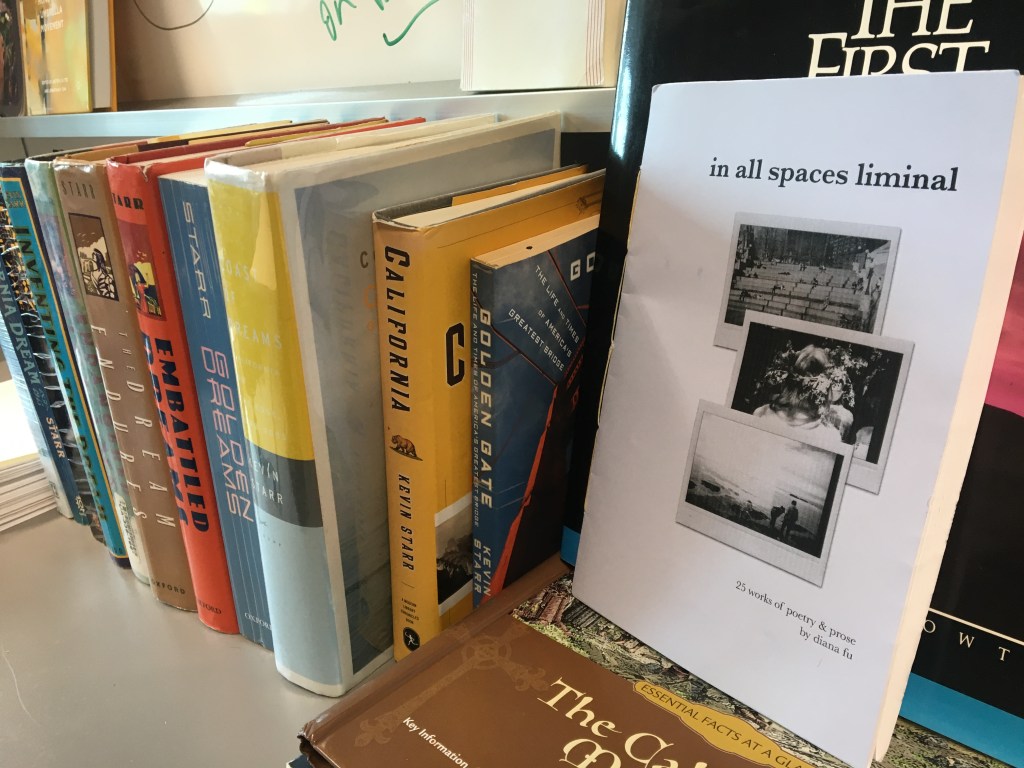
One writer I think with a lot when it comes to this kind of stuff is my dear friend and former student Diana Fu, who is a climate scientist by day and self-publishes poetry especially for her friends to read. Like many of the people I will probably be bringing into dialogue with Balthasar, she’s not Catholic, not even close, but that is the point. Balthasar and Speyr weren’t exactly writing for Catholics or even to advance Catholic theology, even though it seems to be mostly Catholics who read them, and probably because they are so Catholic that it even makes Orthodox me cringe a bit.
Fu has a piece titled ‘Remembering Rain’ in which she writes of the rains she remembers in her California childhood and how by the time she was away as a working adult, drought had visited the land instead. ‘God is in the rain,’ she says her sister used to say. But ‘real godforsaken rain had not fallen in years,’ to the point where a town named Paradise was on fire.
Well, if that isn’t Balthasar’s Glory of the Lord, where beauty has been cast off by modernity as the transcendental by which goodness and truth can be approached. Here we begin, where I and my interlocutors live, in the transpacific, reading a problematic Eurocentric theologian who seemed to have wanted sixty years ago to extend his work into our region. This should be fun. A few pages a day, and I’ll be through the whole triptych, right?
God. This is going to be harder than I thought. Real godforsaken rain had not fallen in years.
 godforsaken geographies
Leave a comment